
Company Updates
Women's health has been overlooked for far too long. Despite making up half the global population, women face persistent gaps in diagnosis, treatment, and research—gaps that have cost lives. The good news? A real shift is underway, and technology is playing a crucial role in accelerating change.
The Scale of the Problem
For decades, women have been under-represented in medical research and health data. This legacy of neglect has real consequences: conditions go undiagnosed, treatments are less effective, and women's voices are often unheard in clinical settings. The World Economic Forum and McKinsey Health Institute estimate that closing the women's health gap could add at least $1 trillion to the global economy every year by 2040—a staggering figure that underscores both the human and economic imperative for action.
But here's what gives us hope: artificial intelligence is emerging as a powerful tool to bridge these gaps. From maternal cardiovascular monitoring to advanced ultrasound imaging and clinical decision support, promising AI applications are already transforming how we diagnose and care for women. The question is no longer whether AI can help, it's how we ensure it's developed responsibly.
Why Collaboration Matters
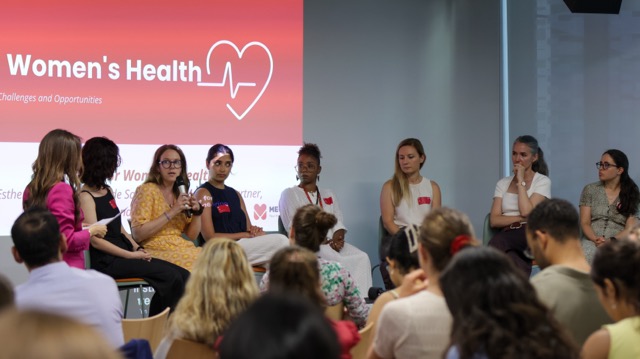
This is where events like AI × Women's Health: Innovation, Challenges and Opportunities become essential.
Organised by MEGI Health and held on 25 June at the London Institute for Healthcare Engineering, this sold-out event brought together 140 innovators, clinicians, researchers, investors, and advocates with many more on the waiting list. The demand alone tells us something important: people care deeply about getting this right.
No single person or organisation has all the answers. Solving women's health requires clinicians who understand patient needs, researchers who can interrogate data quality, technologists who build thoughtfully, investors who fund boldly, and crucially women themselves, speaking up about their experiences. These conversations don't happen in silos. They happen when we gather, listen, and challenge each other to do better.
Innovation With Purpose
Technology is a means, not an end. The real goal is earlier diagnosis, faster access to care, better clinical decision-making, and women feeling genuinely heard by the healthcare system. That means asking hard questions from the outset: Is this data representative? Who benefits from this innovation? What about equity and accessibility? How will this work in the real world?
Responsible innovation in women's health AI requires us to consider ethics, privacy, and implementation alongside capability. It's not enough to build something clever—it has to be fair, it has to be safe, and it has to serve the women it's designed for.
What Comes Next
The momentum is real. More entrepreneurs, investors, researchers, and women are stepping into this space. More events are bringing people together to share knowledge and challenge assumptions. More funding is flowing toward women's health innovation.
But we need to sustain this energy. We need more conversations like the ones happening at AI × Women's Health. We need more collaboration across disciplines and sectors. We need more voices at the table, especially women's own voices.
If you care about women's health, whether as a clinician, researcher, technologist, investor, or advocate—the time to get involved is now. The gap won't close itself. But together, with thoughtful innovation and genuine collaboration, we can build a future where women's health is no longer overlooked, underfunded, or under-innovated.
The shift is underway. Let's make sure it's a shift that counts.
Speakers
-
Nell Thornton – Improvement Fellow at The Health Foundation, leading major research projects on AI, automation and data analytics in healthcare
-
Alexander T Deng – Clinical Geneticist at Guy's and St Thomas' NHS Foundation Trust; Director of the NHS Fellowship in Clinical AI and the NHS Genomic AI Network; Genomic AI theme lead at the Alan Turing Institute
-
Antonio de Marvao – Clinical Senior Lecturer and Consultant Cardiologist at King's College London, specialising in maternal cardiology and using machine learning to understand cardiovascular dysfunction in pregnancy
-
Kimberly Peven – Lead Research Scientist at Flo Health; PhD epidemiologist specialising in women's, maternal and newborn health and digital health research
-
Dika Vilić – Head of Clinical Scientific Computing at Guy's and St Thomas' NHS Foundation Trust; Senior Clinical Scientist in AI and founder of the AI Fairness NHS Working Group
-
Bianca Schor – AI Researcher in Women's Health at Amsterdam UMC; Co-founder of the AI for Women's Health Supra-Interest Group at the Alan Turing Institute; PhD researcher at Cambridge focused on algorithmic transparency and endometriosis diagnostic tools
-
Dr Katy Kuhrt – Specialist Registrar in Obstetrics and Gynaecology; PhD researcher focused on point-of-care diagnostics for maternal health in low-resource settings including Sierra Leone
-
Esther Reynal de St Michel Richardot – Founding Managing Partner of THENA Capital, a MedTech VC fund with a gender-smart investment strategy focused on women's health, oncology and digital health
-
Emily Jin – Researcher at the University of Oxford working on geometric deep learning and computational biology, including AI applications for cervical neoplasia diagnostics
Session Chairs
-
Professor Eugene Oteng-Ntim – Professor of Obstetrics at King's College London; Clinical Director of Women's Health at Guy's and St Thomas' NHS Foundation Trust; over 30 years of experience in obstetrics and gynaecology
-
Richard Dobson – Professor of Medical Bioinformatics and Head of Biostatistics & Health Informatics at King's College London; Deputy Director of the NIHR Maudsley Biomedical Research Centre
-
Prof Asma Khalil – Professor of Maternal Fetal Medicine at St George's Hospital London; Vice President of the Royal College of Obstetricians and Gynaecologists; author of over 500 peer-reviewed papers